The Shadow of Self-Sacrifice
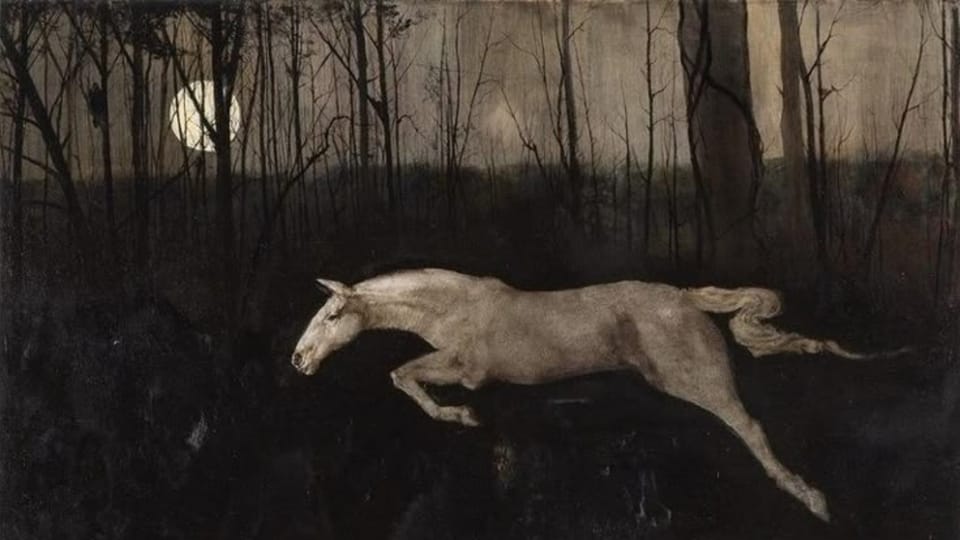
At 27 I stopped believing in Yahweh, that the stories of the Old Testament or the Tanakh were historically true, and that there was a designated place called Hell. At 37 I stopped believing in a designated place called Heaven and in the validity of anything St. Paul said. At 47 I stopped believing that the stories of the Gospels were historically true. One year later, in 2020, I stopped believing in an historical Jesus Christ. Since then I have gone through various phases of hell, purgatory, and heaven in the process of integrating or making sense of my whole life that was wholeheartedly dedicated to this myth.
Jung has helped me tremendously with this. His primary criticism was that Christ represents an incomplete symbol of the Self because he lacks a shadow. He’s portrayed as purely good, which Jung saw as psychologically false and dangerous. Instead of the problematic Trinity, he posited a Quaternity: Father, Son, Spirit, and Lucifer. In Answer to Job, Jung was far more scathing about the divine personality. He described Yahweh (and by extension, the Christ figure as God incarnate) as unconscious, amoral, totally lacking in self-reflection, no insight, savage, ruthless, jealous, despotic, intolerable, less than human.
I have known no one personally that took Jesus as seriously as I did. I read a handful of biblical scholars that resonated with me, but I always felt so alone because no one in my family, friend groups, or church ever seem to take Jesus as seriously as I did, at least in the way I did. He was my master. I worshiped and followed him with the utmost devotion. Had I been born in a different place or time, I most certainly would have died for him. But make no mistake, I sacrificed myself for him in every possible way, save physical death. I sacrificed my desires, gifts/talents, happiness, time, energy, and health (physical, mental, emotional, sexual, and spiritual), all at the altar of Jesus Christ. My constant reward for all of this self-sacrifice was self-loathing, frustration, and unfulfillment.
I do not seek to demystify or oversimplify the myth of Jesus Christ. There are many ways to perceive and understand it. All I claim to do is express, as authentically as I am able, the ways in which I perceive the myth now that I am on the other side of belief. The aspect I am touching on here is his sacrifice, which seems at best tragic and at worst evil. The tragedy of my life as a believer was the time, energy, dreams, and health I sacrificed for Jesus. He did the same for his god, Yahweh. And while one might say his self-sacrifice was greater than mine because he was physically tortured and crucified, his hardship only lasted a few years and the pure agony lasted only a few days. My hardship lasted three decades, a slow death depleting nearly every ounce of my joy, time, energy, and dignity.
Christian scripture has Jesus quoting the opening lines to Psalm 22 as he cries out to Yahweh from his cross, like a heartbroken, betrayed lover, “My God, My God, why have you forsaken me?” Many biblical scholars believe he most likely quoted the whole of Psalm 22. When I was going through the darkest part of my purging/integrating/transmuting, I cried out to the Jesus one last time, on the bathroom floor of a swanky hotel room in Dallas, TX. Psalm 22 was not my song of choice, as I've never enjoyed the Bible. Mine was closer to Kingdom by Dave Gahan, the lead singer of Depeche Mode:
So in your infinite wisdom
Show me how this life should be
All your love and glory
They don’t mean that much to me
Sweat, tears, saliva, and snot oozed out of my face onto the tile as the lyrics above turned into the chant/mantra, “Fuck you! Fuck you! Fuck you!”
Then I became still.
So I might receive.
And finally I received the answer I had been longing for all those years.
Silence. Darkness. Nothingness.
After trying to abandon Jesus for so long, he finally abandoned me.
The following year was its own kind of hell. I was deeply struggling with the question: “What does one do after they’ve devoted their whole life to a god who doesn’t exist?” My creative work, mostly my writing and speaking, is now my answer to that question. My newfound integration is both resistance to systemic oppressive systems (religious, political, cultural, technological, tribal, and familial) and a creative reimagining of what life could be life for me and the world on the other side of that oppression. On the days I’m not totally nihilistic, I’m completely optimistic. My work is to live in the creative tension between those two extremes. Hard work, indeed.
It’s difficult for me to express the internal liberation I feel having finally been freed from the Jesus myth. The guy is just so human to me now. So much beautiful, conscious light in him, you know? He went around telling people how beautiful they were, that they need not feel ashamed, that they were loved, that they could love anyone and everyone if they just believed in themselves. Perhaps he was the original Queer Eye. Then there is this other, dark, unconscious side of him. Where he believes his god is the only god. That his god has sent him to earth to be martyred. That he was sent here as the messiah, to take away my darkness which is actually beautiful and which I actually quite need in order to be fully human. That by allowing truly cruel people to torture and kill him, that somehow this would be good for all the people whom he loved and who loved him. But his death saved no one. In fact, his death just meant now the state would shift their focus to his followers and start picking them off one by one. What a tragic, pathetic legacy, his martyrdom. One could argue that at least we were given the one story where he steps in, just in the nick of time, to put an end to the near stoning of a woman who was just trying to support herself via sex work in a patriarchal and brutal society. He could have gotten himself killed for that. I just don’t think it makes up for his unconscious recklessness, which has inspired untold suffering and death over the past two millennia. I am one of those who was inspired by his reckless, unconscious, self-sacrifice. I chose to follow his path. Christopher literally means follower of Christ.
The best part of the Jesus myth for me is what some call Christ Consciousness. One side of this is collective oneness and the other individuation. One side chooses sacrifice for the whole/the other and one side chooses self-love. So maybe this Jesus character knew all of this at some profound, ultimate level, but on paper, in the myth presented to us, and the way it has played out on the stage of history and in my own life, this has not been the case. From my perspective, the Christian religion has given us extreme forms of masochism and sadism. I’m not saying Christians have not been inspired to devote themselves fully to loving their neighbor as themselves in some beautiful, wonderful, and meaningful ways. It’s just that I don’t think one needs Jesus for this and relegating "love thy neighbor as thyself" to one man as the quintessential role model is both inaccurate and dangerous. Powerful acts of service and sacrifice for others have been and continue to be done by people who identify as Muslim, Jew, atheist, agnostic, Democrat, Republican, straight, queer, man, women, trans, non-binary, etc, etc, etc. If you need proof, watch what’s happening in Minnesota right now. Some historians are already calling it "Neighborism."
What I know is this. Choosing to love life and to love others requires one first love themselves, and in order to love one’s self, one must face and embrace themselves... all that is dark/unconscious as well as all that is light/conscious. The truly ironic and paradoxical aspect of this for me is that it took going as deep as I possibly could into the Christian myth and then untethering myself from it so I could know all of this.
Act I: Tethered is what I choose to call all of my life’s story up until very recently, in which the protagonist was living in a 52-year dream. Act II: Untethered opens with our main character waking up from this dream in order to begin living a new kind of dream taking shape, one in which I’m grateful you are partly witnessing.
Comments ()